
Ronit Ricci

Interlinear Translation of the Month #38

The Study of Islamic Interlinear Texts from Indonesia

October 2025

Ronit Ricci

            Within the context of Textual Microcosms, a research group studying interlinear translation across the Indonesian-Malay world, this blogpost briefly explores the following question: how was the phenomenon of Islamic interlinear translation in Indonesia studied by scholars of earlier generations?

       Before asking “how was interlinear translation studied,” we might do well to wonder whether it was a topic of investigation. We know that some of the earliest extant manuscripts from the region are in the form of interlinear translations from Arabic to Malay (al-Attas 1988; Drewes 1955) and Arabic to Javanese (Arps and Gallop 1991, see Figure 1), and it is also known that there are numerous such manuscripts in libraries and private collections in Indonesia and abroad, thus it is clear that interlinear texts have been around for a long time and in large volume. Was this richness matched by the attention devoted to the phenomenon in the scholarship?

are in the form of interlinear translations from Arabic to Malay (al-Attas 1988; Drewes 1955) and Arabic to Javanese (Arps and Gallop 1991, see Figure 1), and it is also known that there are numerous such manuscripts in libraries and private collections in Indonesia and abroad, thus it is clear that interlinear texts have been around for a long time and in large volume. Was this richness matched by the attention devoted to the phenomenon in the scholarship?

masail_al-talim_british_library


Figure 1. Masāʾil al-taʿlīm, Arabic with Javanese translation and notes, 1623. British Library, Sloane 2645


Read More

In what may be one of the early mentions of interlinear translation in a scholarly publication the famed Dutch linguist Van der Tuuk, writing in the Leiden-based journal Bijdragen tot de taal-,land- en volkenkunde (BKI) in 1866, mentioned an Arabic to Malay interlinear translation of al-Samarkandi’s Bayān ʿaqīdah al-uṣūl (commonly known in Indonesia by its author’s name) in a brief report he published on various Malay manuscripts. There was no detailed description or discussion, but Van der Tuuk was clearly familiar with this popular text and noted that interlinear translations of al-Samarkandi into Javanese in west Java were “numerous” and that there was also, in Batavia, a commentary on the text which had an interlinear translation in Javanese. Finally, he mentioned that he was in the possession of two such commentaries in Sundanese. Based on this fleeting note we can conclude that Van der Tuuk was familiar with the phenomenon, with interlinear translations from Arabic into two or three languages (Malay, Javanese, possibly Sundanese), and with their popularity. There is nothing in his brief paragraph that expresses any surprise or special interest or insight.

       Fifteen years later (1881), writing in the same journal, the philologist A. W. T. Juynboll discussed an Arabic to Javanese interlinear translation of the same text, which he had translated into Dutch. His article, which contained only two pages written by him and ten pages of the interlinear text, was titled “A Muslim catechism in Arabic with a Javanese interlinear translation in pegon script.” All we learn about the manuscript on which his translation was based is that it was brought by one of his students from Java to Holland, and that large parts of it were eaten up by ants. Although Juynboll highlighted the interlinear translation in his article’s title, he seemed interested in authorship, content and textual versions but said nothing of the translation method, its uses or implications. The Dutch translation he produced referred only to the Arabic text, ignoring the potential meanings and nuances of the Javanese interlinear translation and its use as a pedagogical and cultural phenomenon. Although this remains unacknowledged, the Dutch in fact replaced the Javanese as the translation language.

       This type of approach, which viewed interlinear translation as a gateway to questions of content and textual variability but not necessarily as worthy of study in its own right as a translation model, as a pedagogical tool or as a product of a particular culture, seems to have been common amongst colonial scholars in the 19th and early 20th centuries. However, although less common, a different approach was also evident at the time: the work of Van Ronkel stands out for his interest in the translational practice itself and his attentiveness to the detail that is among the hallmarks of interlinear translation. In an 1896 article describing six manuscripts housed at the Cambridge University library he discussed two that included interlinear texts and commented in detail on several of their characteristics. Possibly following that work, as well as an examination of additional manuscripts he encountered, Van Ronkel several years later (1899) published what constituted (and still does) a pioneering attempt to survey the interlinear practice and map its far-reaching effects. Some of Snouck Hurgronje’s work also reflected an interest in the nuances of interlinear translation.

       In general, a broader survey of 19th and early 20thc.  literature on Islamic interlinear translation, which is beyond my scope here, shows that the popularity of this practice was not matched by the scholarship produced about it. What can we glean from this fact, and from the approaches presented, however tentatively? Can we detect in the lack of interest, as has been more generally proposed regarding colonial Dutch scholarship, a bias towards the Hindu-Buddhist and away from the Islamic? The curiosity or lack thereof towards interlinear texts may have been part of the trend, i.e., an enduring interest in the ruins of temples, ancient sculpture, the role of Sanskrit in Old Javanese poetry, while viewing Islam as a “thin veneer” covering prior traditions and possessing a deep-seated anxiety about Islam. It may have also been that interlinear translation was taken at face value, as a convenient way to translate – to transfer meaning efficiently from one language to another – but no more than a technical device. Scholars of the period who were exceptions to the rule in their interest and in the studies that they produced, above all Van Ronkel and Snouck Hurgronje, showed how those who did examine the practice of Islamic interlinear translation more closely discovered its complexity and its implications which were apparent in the linguistic, religious and social spheres. The work of these scholars (and other, more recent ones whose studies lie beyond the scope of this blogpost) points to the richness of interlinear translation as a research topic and to the many yet unanswered questions about it that await investigation.


References:

Al-Attas, S. M. N. The Oldest Known Malay Manuscript: a 16th Century Malay Translation of the ‘Aqa’id of Al- Nasafī. Kuala Lumpur: University of Malaya, 1988.

Arps, B. and Gallop, A. T. Golden Letters: Writing Traditions of Indonesia/Surat Emas: Budaya Tulis di Indonesia. London: The British Library; Jakarta: Yayasan Lontar, 1991.

Drewes, G.W. J. Een 16de Eeuwse Maleische Vertaling van de Burda van al-Busiri (Arabisch Lofdicht op Mohammad) ‘s-Gravenhage: Martinus Nijhoff, 1955.

Juynboll, A.W.T. “Een Moslimsche catechismus in her Arabisch met eene Javaansche interlineare vertaling in pegonschrift.” BKI 29 (1881): 215–227.

Ricci, R. “Interlinear Texts from Indonesia: Preliminary Thoughts on their Study.” Journal of Arabic and Islamic Studies (forthcoming 2025).

Van der Tuuk, H. N. “Aanteekeningen.” BKI 13.1 (1866): 466–467.

Van Ronkel, Ph. S. “Account of Six Malay Manuscripts of the Cambridge University Library.” Bijdragen tot de taal-, land- en volkenkunde 46, 1 (1896): 1–53.

Van Ronkel, Ph. S. Mengenai Pengaruh Tatakalimat Arab Terhadap Tatakalimat Melayu. Trans.Ikram, Jakarta: Bhratara, 1977. First published as “Over de Invloed der Arabische Syntaxis op de Maleische,” Tijdschrift voor Indische Taal- Land- en Volkenkunde 41(1899): 498–528.


Read Less

Interlinear Translation of the Month #35

“Ndang Dao Tubis Sian Bonana”: A Batak Metaphor for Family Continuity and Cultural Inheritance

July 2025

Mery Tambaria Damanik Ambarita

Across the world, cultures have developed rich proverbial traditions to express the belief that children often resemble their parents in character, behavior, or destiny. Whether these reflections are used to praise inherited talent or comment critically on behavioral flaws, the underlying idea is universally understood: we often see the imprint of a parent in their child. This post explores an interlinear translation of such proverb from the Batak region of North Sumatra, Indonesia.

Read More
The Batak proverb "Ndang dao tubis sian bonana" (Figure 1) is translated to Indonesian as “Tidak jauh rebung dari pokok (induknya)”; (ndang=not; dao=far; tubis=bamboo shoot; sian=from; bonana=its parent plant). In English it literary translates as: Not far (is the) bamboo shoot from its parent plant. This translation preserves the syntactic structure of the original Batak while providing semantic clarity. Batak proverbs often utilize concise structures, where the omission of subjects or auxiliary verbs is compensated by the richness of contextual meaning. The absence of a subject draws on collective knowledge to supply the referents. Figure 2 shows the proverb’s literary Batak translation which in literary English is translated as “Not far (is the) child’s character from his/her father’s; (pangalaho=behavior, character; ni=definite article the or “nya” in Indonesian; anakna=his/her child; sian=from; amana=his/her father (ama=father). This translation is more specific in expressing the meaning of the Batak proverb, clarifies the underlying moral principle for audiences who may not immediately grasp the natural symbolism of bamboo, linking ecological imagery to familial resemblance. This interlinear translation plays a critical role in conveying the proverb’s linguistic and cultural layers.

pic1

Figure 1. The Batak proverb with its Indonesian translation (Sitanggang, 1996)

An equivalent variant of the proverb having similar meaning is “Sodao tubu sian bonan” (Siahaan & Barus, 2020); sodao is a variant of ndang dao (so=ndang); tubu is a variant of tubis, representing the new shoot; bonan is the shorter version of bonana, the possessive pronoun of bona. Although morphologically slightly different, both proverbs communicate the same idea, reflecting dialectal or stylistic flexibility in Batak oral and literary traditions. The proverbs blend ecology and ethics with imagery centered on the bamboo shoot which grows closely around the base of the bamboo plant (bonana). It aptly symbolizes familial closeness and the transmission of traits from one generation to the next (ancestry root), to describe family likeness, often with pride or deep cultural meaning, emphasizing the importance of genealogy inherited identity in Batak society.

pic2

Figure 2. The Batak proverb with its Batak translation (Sibarani, 1979)

The use of tubis is significant in typical traditional Batak dishes like arsik (dried stewed seasoned fish) and gantalan (curry made with cowhide and tubis). Bamboo is used in construction, for tools in practical daily life, and for musical instruments (Simanjuntak, et al., 1993). In earlier times it was also used for Batak manuscripts (Pustaha bulu) and calendars which are preserved in museums and libraries. Bamboo typically grows near villages, riverbanks, or rice fields, and is planted to reinforce land, retain water, or serve as natural fences (known as parik) (Simanjuntak, et al., 1993). The translations miss the emotional weight of pride or critique often implied when the proverb is used in context, along with its relevance to everyday life. Bamboo shoots that grow close to their rootstock/clumps (Uchimura, 1981), symbolizes the shared identity within the social structure and kinship system of Batak people (known as Dalihan Na Tolu (“three-legged stove”). Bamboo reflects interconnectedness of hula-hula (the wife’s side’s families), boru (relatives from a female’s side of the clan), and dongan tubu (siblings or relatives of the same clan), which emphasizes inherited social roles, moral responsibility, and family unity, represented by the clumps’ system and growth of bamboo. These cultural values however cannot be captured through the interlinear translation.

The proverb finds parallel in Indonesian proverb, “Sebab buah dikenal pohonnya” or “Madu satu tong jika rembes, rembesnya pun madu jua” (Natia, 1990), expressing also the idea that children resemble their parents. The Malay saying “Melentur buluh biarlah dari rebungnya” (“To bend bamboo, start with the shoot”) emphasizes the importance of early education and the influence of upbringing. The Batak proverb is generally applied under family situations where children grow up within the same environment as their parents.

The significance of interlinear translation lies in its ability to preserve linguistic authenticity while facilitating cross-cultural understanding. By retaining the original Batak structure, it allows scholars and learners to appreciate the language’s conciseness and metaphorical richness. It also highlights the challenges of translating culturally specific concepts, prompting deeper exploration of Batak values. The dual role—linguistic and cultural—makes interlinear translation a vital tool for anthropologists, linguists, and educators seeking to bridge indigenous knowledge with global audiences.

In conclusion, “Ndang dao tubis sian bonana” encapsulates a deep Batak cultural truth through a simple bamboo metaphor. Interlinear translation analysis reveals its linguistic structure and ecological symbolism, while exposing its limitations in capturing the depth of Batak kinship and social values. The interlinear translation of the proverb serves as a vessel for moral and cultural transmission, also encoding shared human experiences within unique cultural frameworks.


References:

https://prpm.dbp.gov.my/

Natia, I Ketut. 1990. Peribahasa & Ungkapan dalam Bahasa Indonesia. Surabaya: Bina Pustaka.

Siahaan, Jamorlan & Barus, Asni. 2022. Form, content of umpama and umpasa in Batak Toba Language: Study of Local Wisdom. TALENTA Conference Series. LWSA Conference Series 05: 51-61

Sibarani, AN Parda. 1979. Umpama Batak dohot Lapatanna. Jakarta: Proyek Penerbitan Buku Sastra Indonesia dan Daerah, Departemen Pendidikan dan Kebudayaan.

Simanjuntak, Belam, Sitanggang, Toga, & Sianipar, Parulian. 1993. Dapur dan alat-alat memasak tradisional daerah Sumatra Utara. Jakarta: Proyek Penelitian Pengkajian dan Pembinaan Nilai-Nilai Budaya.

Sitanggang, SRH. 1996. Tradisi Umpasa Suku Batak Toba dalam Upacara Pernikahan. Jakarta: Pusat Pembinaan dan Pengembangan Bahasa. Departemen Pendidikan dan Kebudayaan.

Uchimura, Etsuzo. 1980. Bamboo Cultivation. Proceeding of a Workshop on Bamboo Research in Asia. Ottawa: International Development Research Centre: 151-160


Read Less

Interlinear Translation of the Month #32

Arabic to Malay and Maranao: Interlinear Translation in a Collection of Hadiths from Mindanao                                  

April 2025

Kawashima Midori

This blog post examines the characteristics of the interlinear translation found in a collection of hadiths produced by Islamic scholars from the Lanao region of the island of Mindanao in the Philippines (B7-Ms8, Collection of Sheik Muhammad Said bin Imam sa Bayang at the Imam As-Saadiq (A.S.) Library in Marawi City). The Lanao region is located around Lake Lanao in the central part the island and is inhabited by the Maranao people, a Muslim ethnic group in the Philippines who speak the language of the same name. Islamic books and manuscripts written in Malay in modified Arabic script were used by Islamic scholars and students in the region as primary sources of religious knowledge until the mid-20th century. Some of these materials include interlinear translations from Arabic to Malay. Maranao Islamic scholars adopted the practice of interlinear translation from Arabic to Malay and created an interlinear translation from Arabic to their own language, Maranao.

Read More
This hadith collection is unique because it has a Maranao interlinear translation, albeit partial, in addition to a Malay interlinear translation (see Figures 1 and 2). 

pic1

Figure 1: Kitāb al-ḥādīth. B7-Ms8, Collection of Sheik Muhammad Said bin Imam sa Bayang, Marawi City. ff. 23v-24r.

pic2

2a. f.23r.

pi

2b. f.23v.

Figure 2: Kitāb al-ḥādīth. B7-Ms8, Collection of Sheik Muhammad Said bin Imam sa Bayang, Marawi City.

The Malay interlinear translation is provided throughout the work, whereas the Maranao interlinear translation is only provided for one hadith and is written in different handwriting and ink. The unique handwriting suggests that this Maranao text was written by Sheik Muhammad Said bin Imam sa Bayang (c. 1902–1974), for whom the collection is named, between 1930 and 1974.

The Arabic text and its English translation are as follows:

من تكلم بكلام الدنيا في خمسة مكان بعث الله تعالى يوم القيامة كصورة الخنزير

Whoever speaks worldly words in five places, Allah the Exalted, will raise him on the Day of Resurrection in the form of a pig.

The texts in the three languages and the English translation of the Arabic text are as follows.

pi

pi


The Arabic text has been translated word for word into Malay and Maranao, maintaining the original word order. The Malay words are written diagonally from top right to bottom left below the corresponding Arabic words and divided according to the Arabic spacing. The Maranao text is written below the Malay text, also diagonally from top right to bottom left. However, unlike the Malay text, the spacing is not always clear. Instead of clearly separating each word and placing it directly below the corresponding word, the Maranao text tends to be written continuously without spaces, as in the first line of this hadith. Consequently, the word dalem (in) is not written below the corresponding Arabic and Malay words and pada, but in the next line. The characters in the Malay text are much smaller than those in the Arabic text; however, the Maranao text is written in larger characters than the Malay text.

In the Malay and Maranao translations, words that frequently occur in the Arabic text are consistently rendered with specific words. For example, the Arabic prepositions bi and are often rendered with the Malay words dengan and pada, and the Maranao words sa and dalem, respectively, as seen in this hadith. The Arabic expression “man + verb” meaning “whoever does this and that” is consistently replaced by the Malay and Maranao expressions “barangsiapa (whoever) + verb” and “si/so taw (the person) a + verb,” respectively.

Maranao language has a unique feature not found in Arabic or Malay: it has many particles such as ligatures that link words (e.g., a, na) and determiners that mark the relationship between words (e.g., so, si, o, ko, sa). Therefore, if Arabic or Malay words were translated strictly word for word into Maranao without these particles, the relationships between words would not be indicated, resulting in disjointed sentences that are difficult to understand. The Maranao translator included these particles in the interlinear translation at the expense of not strictly following the Malay interlinear translation convention of writing the translation directly under the corresponding word. Thus, he was able to form coherent sentences within the limited space between the lines.

Was the Maranao text translated from the original Arabic text or the Malay translation? Since the contents of the Arabic and Malay texts are essentially the same, answering this question by comparing them is difficult. In the Lanao region in the mid-20th century, reformist Islamic scholars were increasingly interested in prioritizing the original Arabic text in Islamic learning. Given this contemporary social context, the translator probably based the Maranao translation primarily on the Arabic text to ensure that its meaning was accurately conveyed, while also referring to the Malay translation to verify the meaning.

This argument is supported by the text of another hadith in the same manuscript, which reads: Man fasada qalbahu gharaqa fī āfāti al-dunyā (Whoever has a corrupt heart will drown in the troubles of this world) (Figure 3).

pic4

Figure 3: Kitāb al-ḥādīth. B7-Ms8, Collection of Sheik Muhammad Said bin Imam sa Bayang, Marawi City. f. 24r.

The Arabic word āfāt is a plural form of afah (harm, damage, ruin), which is translated into Malay as pekerjaan (work, job). The Maranao translator was not satisfied with this translation and wrote down the Maranao word pakabinasa (it can bring destruction) as the meaning of āfāt. This single word, which could easily be overlooked as a meaningless scribble, proves that the translator did not simply accept the Malay interlinear translation, but critically examined and corrected it based on the Arabic language. Thus, by carefully reading between the lines, we can explore a realm that we would not have found from the main text alone.


References:

Fathurahman, Oman, Kawashima Midori, and Labi Sarip Riwarung (eds.). 2019. The Library of an Islamic Scholar of Mindanao: The Collection of Sheik Muhammad Said bin Imam sa Bayang at the Al-Imam As-Sadiq (A.S.) Library, Marawi City, Philippines: An Annotated Catalogue with Essays. (Occasional Papers No.27). Tokyo: Institute of Asian, African, and Middle Eastern Studies, Sophia University.

Ricci, Ronit. 2016. Reading between the Lines: A World of Interlinear Translation. Journal of World Literature, 1: 68-80.

Photographs: Kawashima Midori et al., February 27, 2012.

I would like to thank Dr. Moctar Matuan for his advice on the Maranao language, although I take full responsibility for any errors.


Read Less

Interlinear Translation of the Month #31

Interlinear Translation in Print (Part II)

March 2025

Ronit Ricci

An earlier blog post, Interlinear Translation in Print (Part I, see here), briefly introduced the story of Muslim printing in the Indonesian-Malay world, in which the publishing of interlinear translations from Arabic into Malay and Javanese formed a chapter. As part of that introduction the blog post presented a small booklet published by Sulaiman Mar’i and Co. in Surabaya, likely in the 1950s, and titled Kitāb Maslaku al-akhyāri fī al-ad‘iyati wa al-athkār al-wāridatu ‘an al-nabī al-mukhtār (“The Path of Good People regarding the Supplications and Remembrances Received from the Chosen Prophet”). The Kitāb contains an Arabic to Malay interlinear translation which will be discussed in more detail below, touching upon three points: the Kitāb’s content, aspects of gender in the source and its translation, and the role of interlinear translation in such a publication.

Read More

The Kitāb contains many small texts with interlinear translations into Malay in the categories of doa (prayer, supplication), dhikir (remembrance of God), talqīn (exhortation to the dead), wirid (a recitation of supplications or Qur’anic verses),  and ṣalawāt (invocations of God’s blessings) to be recited on specific occasions. There are, for example, doa to be recited upon waking from sleep, when washing the left and right feet, on a person’s sickbed, when a very strong wind blows, or when one hears a dog bark. Some are to be recited daily or nightly while others are meant to be recited annually, for example a doa for the last day of the year or for Idul Fitri. Sections in Malay that offer explanation and guidance appear among the Arabic texts. Several prior sources are mentioned including the 17th century Hadrami scholar ‘Abdallah ibn ‘Alawī al-Ḥaddād’s rātib and wirid.

The issue of gender caught my attention while reading the Kitāb. Generally, in translating Arabic between the lines translators had to almost constantly acknowledge the basic structural differences between Arabic and Malay, with one among them the role of gender in the construction of words and sentences. In Arabic inflected verbs, nouns, adjectives and most pronouns are gendered, but they are not so in Malay. One implication, for example, is that in an Arabic sentence it is clear if a figure being depicted is male or female whereas the Malay translator would often need to clarify this point with additional words, e.g. the Arabic word walad (boy) and bint (girl) might both be translated into Malay as anak (child) but for clarification the translator could add laki-laki (anak laki-laki, boy) or perempuan (anak perempuan, girl). In many cases such an addition seems to have sufficed because once it was clear if the figure was male or female, a relatively simple clarification to add in Malay, adjectives, pronouns and verbs that could not be inflected for gender remained gender-neutral but the reader could surmise who they were referring to.  

A similar example to what was described above is found on page 52 of the Kitāb (see Figure 1) where the believer asks of God that the rewards of praising Him benefit several categories of the dead: Muslim men and women, almuslimīn wa almuslimāt, is translated beneath the line as sekalian Islam laki-laki perempuan (all Muslims, men [and] women/male [and] female) while male and female believers, almu’minīn wa almu’mināt, is translated as sekalian mu’min laki-laki perempuan (all believers, men [and] women/male [and] female).

pi

Figure 1. Kitāb Maslaku al-akhyāri fī al-ad‘iyati wa al-athkār al-wāridatu ‘an al-nabī al- 

mukhtār, 52.

The Kitāb presents some alternatives to this typical model of addressing gender.

For example, on p. 21, there is a Malay note preceding a doa:

Ini doa dibaca kepada kanaq2 kecil laki2 atau perempuan (“this doa is to be recited on behalf of little boys or girls”), followed by the Arabic prayer and its translation (see Figure 2). Interestingly, the verb in the doa itself is in the masculine: u‘īdhuka, I protect you/seek refuge for you, with the suffix ka indicating the masculine, translated as aku lindungkan engkau (engkau being a gender-neutral form of “you” in Malay). We find here a variation: rather than a clarification appearing between the lines a Malay paratext frames the Arabic doa, explaining that it is valid for both boys and girls.

pi

Figure 2. Kitāb Maslaku al-akhyāri fī al-ad‘iyati wa al-athkār al-wāridatu ‘an al-nabī al- 

mukhtār, 21.

In several instances in the Kitāb we find Arabic rather than Malay additions that are gender-related, on which the translator remained silent. In a translation of al-Ḥaddād’s wirid  there is a section asking for the goodness of this day (khayr hadhā al-yawm: yawm, day, is masculine and therefore the demonstrative pronoun hathā is also in the masculine, and translated into a gender-neutral Malay kebajikan ini hari) and protection from the evil of this day and all evil that is in it (sharri hadhā al-yawm). Twice on the margins is added hadhihi al-laylati, that is the plea for wellbeing and protection from evil is extended through this small addition also to nighttime (layla) which is feminine in Arabic and requires the demonstrative hadhihi (see Figure 3). There is no Malay addition on the margin or between the lines that addresses this expansion of the prayer. Another example that does include a directive is found on page 30 -31 where to the masculine yā ‘abd Allāh (“O God’s slave”) is added a marginal note in Malay: jika perempuan yā amat Allāh (“if female [say]: O God’s female slave”). Despite the instruction of how to change the Arabic phrase here too the change is not reflected in the interlinear translation.

pi

Figure 3. Kitāb Maslaku al-akhyāri fī al-ad‘iyati wa al-athkār al-wāridatu ‘an

        al-nabī al-mukhtār, 66.

Interlinear translations had different aims and functions. Several previous blogposts in this series have highlighted the relationship between interlinear translations and the study of Arabic. The little Kitāb discussed here seems less geared towards the teaching of the Arabic language and more focused on understanding the meaning of some doa and dhikir recited daily, annually or periodically. Within this general aim, the instances of noting or emphasizing gender difference and how to adjust the prayers for girls and women may point to the everyday, routine use of these prayers and to the need to recite them correctly for male and female believers in order to maximize their efficacy. It may also be that the gender-related notes hint at the particular period during which the Kitāb was published. Clearly, the translation of gender as expressed in Arabic into Malay was not monolithic and further research and comparison are needed in order to better understand and categorize its intricacies, and its potential effects on devotional practices.


References:

Anonymous. Kitāb maslaku al-akhyāri fī al-ad‘iyati wa al-athkār al-wāridatu ‘an al-nabī al-

mukhtār. Surabaya: Sulaymān Mar‘ī and Co., no date.

Proudfoot, Ian. Early Malay Printed Books. A provisional account of materials published in the

Singapore-Malaysia area up to 1920, noting holdings in major public collections.

Kuala Lumpur: Academy of Malay Studies and The Library, University of Malays, 1993.


Read Less

Interlinear Translation of the Month #30

Sundanese Interlinear Translation: Kiai Ahmad Sanusi’s Sirāj al-adhkiyā’

February 2025

Oman Fathurahman

This blogpost will briefly deal with one of K.H. Ahmad Sanusi’s works, entitled Sirāj al-adhkiyā’ fī tarjamat al-azkiyā’ (“Light for the clever  in translating the book of Azkiyā’”), which may represent the phenomena of interlinear translation in the Sundanese Islamic literary tradition in the late 19th century and early 20th century.

Read More

The text is a translation of Hidāyat al-adhkiyā’ ilá arīq al-awliyā’ (“Guidance for the clever  towards the path of saints”), a rhymed poetic treatise by an Indian great poet and Sufi, Zayn al-Dīn al-Malībārī (d. 1521 AD). Sirāj al-adhkiyā’ contains 188 verses on spiritual guidance to help one get closer to Allah, and advice to be patient, sincere, and liable to Him (Sanusi n.d.).

The author, Ahmad Sanusi (1888-1950) was one of the most prolific Sundanese Muslim authors in the early 20th century. His works, written mostly in Arabic and Sundanese but also in Indonesian (Malay), cover various Islamic fields, including Quranic exegesis (tafsīr), adīth, Islamic Jurisprudence (fiqh), theology (tawīd), and sufism (taṣawwuf). He actively criticized some religious practices that he regarded as “unjustified” according to Islamic teachings. Among his works are those written in Arabic with Sundanese interlinear translation (composed in  Pégon-Sunda, Sundanese written in Arabic script) including the work I am dealing with.

The Sirāj al-adhkiyā’ is found as a printed lithograph kitab which reflects the development of print culture since the late 19th century. It is part of about 60 kitabs that belonged to Husen Hasan Basri, who collected them from his family and colleagues in Sukabumi, West Java, and then donated to me to be preserved and studied.

pi

Figure 1. Cover of Sirāj al-adhkiyā’ fī tarjamat al-azkiyā’

The author put a brief description of this work in Sundanese, which is found on the cover (see Figure 1): “Sirāj al-adhkiyā’ fī tarjamat al-azkiyā’…damarna kabagjaan buat jalma-jalma anu caralakan dina narjamahkeun kitab Azkiyā’, dikumpulkeun disusun ku kaula anu da’if Haji Ahmad Sanusi bin Haji Abdurrahim, Gunung Puyuh pukhel weh 100, Sukabumi (“Light of happiness for those who are bright in translating the book of Azkiyā’, compiled and arranged by me, the humble Haji Ahmad Sanusi…”). An ownership note is found at the top: “Hak Husein Hasan Basri”, indicating that this copy previously belonged to him. An elaborate explanation in Pégon Sundanese is also found on the left and right margins of each page (see Figure 2).

pi

Figure 2. Muqaddimah (Introduction) of Sirāj al-adhkiyā’ fī tarjamat al-azkiyā’

While the interlinear translation tradition is very popular in the context of the Malay-Indonesian world, particularly in Malay and Javanese texts since the 17th century, it is not until the late 19th century that such works could be found within the Sundanese tradition. Ahmad Sanusi is one of only a few Sundanese authors who dedicated their scholarship to writing religious works with such Sundanese Pégon interlinear translation.

The text is complete, discussing four stages of Islamic mystical doctrines, namely: sharī‘ah, arīqah, aqīqah, and ma‘rifah, through which the soul of the seeker in the Sufi tradition has to pass for eternal union with God (see Figure 2). These four stages are very popular in the discourse of Sufism in the Muslim world, both in Indonesia and beyond. We can find such a discussion, for instance, in the 17th century Arabic Sufi texts by Indonesian Muslim scholars, such as Tanbīh al-Māshī by ‘Abd al-Ra’ūf al-Sinkīlī (Fathurahman 1999). The main message of such a treatise is to apply a rapprochement between the esoteric (taṣawwuf) and exoteric (sharī‘at) aspects of Islam. Ahmad Sanusi based his explanation on some great Sufi and ḥadīth treaties such as Iya’ ‘Ulūm al-Dīn by al-Imām al-Ghazālī (d. 1111), ‘Awārif al-Ma‘ārif by al-Suhrawardī (d. 1234), and Riyā al-Ṣāliīn by al-Imām al-Nawāwī (d. 1277).

In this blogpost I will not elaborate on these doctrines. Rather, I would like to highlight some characteristics relating to the Pégon interlinear translation of this work instead. I am assuming that such characteristics may be found as well in other works by Ahmad Sanusi.

It seems that Ahmad Sanusi did not aspire to put only a word-for-word literary Pégon interlinear translation between the lines. Rather, he sometimes inserted also a kind of interpretation (tafsīr) for certain words. The word تهليل – “tahlīl” (p. 29) for instance, a form of dzikir, is translated as “dzikir lā ilāha illallāh” (utterance of “there is no God but Allah”), or the word فعليه – “fa ‘alayh” (p. 4) which literally means “maka wajib kepadanya” (“then it is obligatory for him”), is interpretated as “maka wajib ka anu hayang wusul ka Allah” (“then it is obligatory for those who want to  connect to Allah”) (see Figure 3).

pi

Figure 3. Part of pages 4, 22, 29 of Sirāj al-adhkiyā’ fī tarjamat al-azkiyā’

Another characteristic is that Ahmad Sanusi consistently applied the traditional model of translation practiced in pesantren (traditional Islamic education institution) called ngalogat (Sundanese) or ngapsahi (Javanese), in which he translated an Arabic word into Pégon-Sundanese and added certain words that represent Arabic grammatical markers.

He, for instance, always put the word ari before a Sundanese word representing the subject of a sentence in Arabic (mubtada’), and éta before a word representing the predicate of a sentence in Arabic (khabar mubtada’). Both ari and éta are just markers in terms of Arabic grammar, and not separately and semantically translated. The interlinear translation for the word فشريعةfa sharī‘ah, for instance, is ari syari’at (“sharī‘ah is”), and the word كسفينةka safīnah is éta saperti parahu (“like a ship”) (Figure 2: p. 2, line 3). Such a translation strategy may relate to the fact that K.H. Ahmad Sanusi was a leader of Pesantren Cantayan, Sukabumi, where he addressed such works especially to his own audience.

It is interesting to find a rather “modern” Pégon interlinear translation word taken from Malay when Ahmad Sanusi translated واجهد لتحضر في صلاتك قلبكwa ijhad li tahura fī alātika qalbaka - as: kudu enya-enyaan manéh buat ngahadirkeun dina salat manéh kana haté manéh…(“please be serious in order to be present in your heart during your prayer”) (Figure 3). He chose the Malay word buat (“in order to”) to translate the Arabic “lam” (لام للتعليل) rather than choose a Sundanese word of translation. The use of this word may indicate the influence of Malay on Ahmad Sanusi’s Sundanese translation.

This blogpost represents a first step in understanding Ahmad Sanusi’s translation strategies. Further research is needed to elaborate on the characteristics of Sundanese Pégon interlinear translation and its significance in terms of the Indonesian Islamic intellectual tradition, particularly in the early 20th century.


References:

Fathurahman, Oman. 1999. Menyoal Wahdatul Wujud: Kasus Abdurrauf Singkel Di Aceh Abad Ke-17. Bandung-Jakarta: Mizan-EFEO.

Sanusi, Ahmad. Sirāj Al-Adhkiyā’ Fī Tarjamat al-Azkiyā’. Sukabumi, West Java.


Read Less

Interlinear translation of the month #25

Interlinear Translation in Print (Part I)

September 2024

Ronit Ricci

The publishing of interlinear translations is part of the larger story of print within Muslim circles in the Indonesian-Malay world. The earliest Muslim printing in the region goes back to at least 1854 when copies of the Qur’an with notes in Malay were printed in Palembang, however it was Singapore that emerged as the leading nineteenth century center of Muslim publishing in Southeast Asia. In the latter part of the nineteenth century, beyond the presses of Southeast Asia, Malay and Javanese books were printed in Cairo, Istanbul, Mecca and Bombay (Proudfoot 1993: 27). Some of these books were in the form of interlinear translations, with an Arabic text and Malay or Javanese translations or glosses appearing between the lines. For example, approximately twenty such Javanese books were published in Singapore between 1890 and 1910 (Proudfoot 1993: 29).

Read More
One interesting aspect of early Islamic print in the region is that books were made in a way that sought to reproduce the graphic form of the manuscript. As regards our topic of interlinear texts, Proudfoot notes that “for kitab in particular, lithography reproduced interlinear glosses, commentary and the like, using customary devices of text layout and script size to express hierarchies of textual authority.” (Proudfoot 1993: 45). Nico Kaptein (1993: 357), in his discussion of a 1853 printed copy of the Mawlid Sharaf al-Anām from Surabaya with a Malay interlinear translation, also very much resembling a manuscript, suggested that this was the oldest known printed book from the Dutch East Indies to be produced outside European-controlled circles. The fact that this pioneering book was interlinear could point to the importance of interlinear translations in manuscript form at the time, especially within the Islamic religious-pedagogical sphere, and the need to include, from an early stage, those same translations with their particular format in the evolving realm of the new print media.
As an example of this genre, and as a step towards considering interlinear translation in print, this blogpost briefly introduces a small printed book containing an Arabic to Malay interlinear translation, while a followup blogpost will delve into its content. The book is a kitab titled Maslaku al-akhyāri fī al-adiyati wa al-athkār al-wāridatu ‘an al-nabī al-mukhtār (“The Path of the Righteous  regarding the Supplications and Remembrances Received from the Chosen Prophet”). As its title implies, it contains supplications (doa), chants of remembrance (dikir) and additional prayers attributed to the Prophet. The book carries no date, however on its final page appears a call to those “wishing to acquire books that are cheap and neatly printed to please get books from the book shop of Sulaymān Mar‘ī and Co. Surabaya, as all book shops across Indonesia acquire their books from Sulaymān Mar‘ī and Co. book shop in Surabaya-Java.” This appeal, which includes the designation “Indonesia,” indicates that the state had already been founded at the time of print, likely in the early 1950s.
Who was the book’s publisher? Sulaymān Mar‘ī, an Arab, was initially based in Surabaya and later (around the mid-1920s) moved to Singapore. He was a bookseller who for the most part carried out his printing offshore, much of it in Egypt. His offshore printing was “an immense technical advance” over the old Singapore lithographs (Proudfoot 1993: 45) and he also had an advantage over competitors in the Indies as the colonial government at the time levied import taxes on paper but not on printed books (van Bruinessen 1990: 233). Among the books he commissioned for sale in the Indies was the Qur’an, printed not in Egypt but in Bombay in 1928 (Hakim Syukrie 2023). Sulaymān Mar‘ī and Co. closed down in the early 1980s (van Bruinessen 1990: 233).
Figure 1. Title page of the kitab Maslaku al-akhyāri fī al-ad‘iyati wa al-athkār al-wāridatu ‘an al-nabī al-mukhtār


Figure 1. Title page of the kitab Maslaku al-akhyāri fī al-ad‘iyati wa al-athkār al-wāridatu ‘an al-nabī al-mukhtār
 
The title page of the kitab is written mostly in Malay, with two exceptions: the title is in Arabic, as is the note at the bottom of the page stating that the book was “printed at the expense of Sulaymān Mar‘i and Co. Surabaya with the permission of Sayyīd Muḥammad bin ‘Aqīl bin Yaḥyā.” The writing, excluding the note about the publisher, is surrounded by a double-lined thin black frame and a large X shaped sign made up of four thin lines divides the page into four parts, two of which “face” the reader while a third “faces” the right side of the page and the fourth its left side (see Figure 1). This type of multi-directional writing on the page is reminiscent of many interlinear manuscripts in which the translation is written upside down or facing a different direction than the main text, or to which various notes are added on various parts of the page. The bi-lingual nature of the book is evident on this opening page in two ways. First, in the top section, the title itself is appended with an interlinear translation into Malay. Second, in the bottom and largest section there is an explanation about how many of the reward-bearing doa and dikir are often written in Malay mixed with Arabic that does not indicate correct pronunciation (unvocalized Arabic?), perhaps implicitly pointing to the main reason why a full interlinear translation of such texts was necessary, and presented in the kitab.
 
References:
Anonymous. Maslaku al-akhyāri fī al-ad‘iyati wa al-athkār al-wāridatu ‘an al-nabī al-mukhtār.
            Surabaya: Sulaymān Mar‘ī and Co., no date.
van Bruinessen, M. “Kitab Kuning; Books in Arabic script used in the pesantren milieu;
Comments on a new collection in the KITLV Library.” Bijdragen tot de Taal-, Land- en
            Volkenkunde 146, 2/3 (1990): 226-269.
Kaptein, Nico. “An Arab Printer in Surabaya in 1853.” BKI 149.2 (1993): 356-362.
Proudfoot, Ian. Early Malay Printed Books. A provisional account of materials published in the
Singapore-Malaysia area up to 1920, noting holdings in major public collections.
Kuala Lumpur: Academy of Malay Studies and The Library, University of Malays, 1993.
Syukrie, A. Hakim. “Pencetakan kitab-kitab Jawi di Bombay India Abad ke-19M.” Indonesia LivingQuran (7 April 2023).
Accessed 8 September 2024.
 
 
Read Less

Interlinear Translation of the Month #20

Transmitting and Translating a Timbuktu Theological Poem in Aceh

April 2024

Zacky Khairul Umam


Private collections of manuscripts that have been digitized often contain non-major texts studied in specific settings where histories of translation and transmission could be retold in many ways. The Teungku Mukhlis Collection in Aceh, for instance, possesses manuscripts of religious texts some of which remain unidentified and little known until today. One amongst this collection, manuscript EAP329-1-95 contains various translations into Malay of texts on tajwīd (the art of Quranic recitation), law, the Quranic Verse of Light (Q. 24:35), and theology. This blogpost will highlight the final part of the manuscript: a versified theological text written by a Timbuktu scholar. This text provides an example of an interlinear translation from the Indonesian-Malay world.

How did a text from Timbuktu, a poetical rarity in the manuscript libraries of Southeast Asia, end up in Aceh?  The text, namely ʿAqīdat al-Wangarī (“The Creed of Wangarī”), often written in its Arabicized version as al-Wankarī, is a hitherto single-known copy of this text in Sumatra, lacking a colophon and the name of its scribe. Considered as a text within the long tradition of Ashʿarīsm—the major theological Sunni school in the Muslim world and in Southeast Asia in particular—ʿAqīdat al-Wangarī is a poetic explanation on the minor creed of Muḥammad b. Yūsuf al-Sanūsī (d. 1490). Umm al-barāhīn (“The Foundational Proofs”), al-Sanūsī’s work, was probably transmitted from the early seventeenth century onwards and became extremely popular because of its Malay translation and commentary, namely Bidāyat al-hidāyah (“The Beginning of the Guidance”) authored by Muḥammad Zayn b. Fāqih Jalāl al-Dīn al-Āshī (d. 1757). Al-Sanūsī’s strategy for popularizing Ashʿarīsm by writing diverse theological texts (Bruckmayr 2017; Caitlyn Olson 2020) was probably adapted in the early modern period by various scholars, including al-Wangarī and Muḥammad Zayn.

Figure 1. Wangarī’s Creed. EAP329-1-95, the British Library

Figure 1. Wangarī’s Creed. EAP329-1-95, the British Library, image 80.

Read More

Who was al-Wangarī? In the beginning of ʿAqīdat al-Wangarī, the author’s name is mentioned as Muḥammad b. Aḥmad al-Wangarī (see Figure 1). Several manuscripts in the National Library of France in Paris bear his full name (see Figure 2; cf. Figure 3) before the beginning of this work: qāla al-shaykh al-faqīh al-muḥaqqiq al-mudaqqiq al-naḥwī al-uṣūlī Abū ʿAbdillāh Muḥammad b. Aḥmad b. Maḥmūd b. Abī Bakr Baghyugh. This scholar, known as a jurist, grammarian and theologian, is most likely the descendant of a well-known Timbuktu scholar who originally came from Djenné, in present-day Mali, Muḥammad al-Wangarī al-Timbuktī al-Jinnawī (d. 1594), known as Baghayogho, whose manuscript library was cited by the celebrated Timbuktu historian Aḥmad Baba (d. 1627) (see Jappie & Diagne 2008).

Figure 2. Wangarī’s Creed in Maghrebi script. BnF Paris, Arabe 5602 ff. 402b-403a.      Figure 2. Wangarī’s Creed in Maghrebi script. BnF Paris, Arabe 5602 ff. 402b-403a.

Figure 2. Wangarī’s Creed in Maghrebi script. BnF Paris, Arabe 5602 ff. 402b-403a.

Figure 3. Wangarī’s Creed in Maghrebi script. BnF Paris, Arabe 5484 f. 143a.


 Figure 3. Wangarī’s Creed in Maghrebi script. BnF Paris, Arabe 5484 f. 143a.


The transmission of Sanūsī’s works in Timbuktu can be well understood due to its geographical proximity to North Africa. But how did Timbuktu’s commentary on al-Sanūsī travel to Sumatra? Lebe Bandar, an unknown scholar and scribe in the early eighteenth century in the Sultanate of Aceh, wrote a prose commentary based on ʿAqīdat al-Wangarī, namely Al-Laṭāʾif al-nafsiyyah ʿalā naẓm al-ʿaqīdah al-sanūsiyyah (“The Psychic Subtlety Commenting on the Minor Creed of Sanūsī”). He noted that he learned of Wangarī’s text when he was in Medina at the end of the seventeenth century. This historical note corroborates the fact that the Hijāz was the most important transmission site of intellectual traditions to the Malay world. If we accept Lebe Bandar’s note, ʿAqīdat al-Wangarī very likely came to Aceh at this time, if not earlier, and this milieu encouraged the scholars in the  Sultanate of Aceh to study it closely, leading Muḥammad Zayn to compose his Bidāyat al-hidāyah in ‘the tongue of Jāwī/Malay” (lisān al-Jāwī). Bidāyat al-hidāyah was able to complement or even replace in popularity the theological works of earlier scholars such as Nūr al-Dīn al-Rānirī (d. 1658) and ʿAbd al-Raʾūf al-Jāwī al-Fansūrī (d. 1693).

Despite the popularity of Muḥammad Zayn’s commentary on al-Sānūsī’s work, ʿAqīdat al-Wangari continued to be recited, perhaps because the credal poem possessed a mnemonic function and was memorized up to the first half of the of the nineteenth century when the manuscript EAP329-1-95 was compiled. The single copy of this Arabic text with its Malay interlinear translation does not mean that it was not popular earlier, prior to the Dutch-Aceh War (1873-1904). It nevertheless at least testifies to an intellectual and textual connection between distant corners of the Islamic world at the time: Timbuktu, the Islamic learned culture far to the west, and Southeast Asia, the Islamic region far to the east.

Comparing three manuscripts—one from Aceh and the other two from the Maghreb  - which are currently kept in the National Library of France—the Acehnese manuscript lacks the indication of Wangarī’s full name at the beginning of the text as well as book divisions such as ‘introduction’ (muqaddimah), the ‘absolute attributes of God’ (mā yajib fī haqq mawlānā tabāraka wa taʿālā), and other Ashʿarī theological doctrines. The function of such subdivisions makes it easier for the readers to distinguish between the sections, thus they can skip from one to the other for subsequent perusal. The Acehnese manuscript differs from the two Maghrebi copies in the way in which the scribe copied it from other older manuscripts. Although the three manuscripts date back to ca. 1750-1850, they certainly have different stories. The history of texts and books is always fascinating when one considers their variants and translations. The Malay interlinear translation of ʿAqīdah al-Wangarī, as can be seen in Figure 1, itself attests to two types of interlinear translation: one is literal, word for word, and can be read throughout the text. The second is an irregular translation, which can be recognized already in the first line of the text:

Yaḥmadu rabbahu bi-khayri al-aḥmadi          al-Wangarī ibn Muḥammad ibn Aḥmadi

Sentiasa memuji oleh Wangari itu akan Tuhannya dengan sebaik-baik puji….

(“Always praised by the Wangari is his Lord with the best of praises”)

At the time when the translator wrote her/his translation, other explanatory elements were added above the words or in marginalia. While the Acehnese manuscript lacks Wangarī’s full name, for instance, the translator/scribe added the meaning of the word ‘al-Wankarī’ in the upper position or copied it from another text in Arabic and Malay: ayy al-mandūb [sic!; al-mansūb] ilā al-Wankarī, artinya dibangsakan negeri Wankari (i.e., “it refers to the territory of Wangarī”). An intriguing question that requires  further study  is how and why some  Arabic theological terms were partly translated  into Malay while others were left untranslated. This text opens a window to the rich tradition of Malay interlinear translation as practiced in Aceh and as found in the EAP Aceh collection, the books of which were used as part of an Islamic curriculum in the region. 


References:

Bruckmayr, Philipp. “The šarḥ/ḥāshiya Phenomenon in Southeast Asia: From al-Sanūsī’s Umm al-Barāhīn to Malay Sifat Dua Puluh Literature.” Mélange of IDEO 32 (2017).

Jeppie, Shamil and Souleymane Bachir Diagne (eds.). The Meanings of Timbuktu. Cape Town: South Africa (2008).

Olson, Caitlyn. “Beyond the Avicennian Turn: The Creeds of Muḥammad b. Yūsuf al-Sanūsī (d. 895/1490).” Studia Islamica 115, no. 1 (2020): 101-140.

Zacky Khairul Umam was a postdoctoral researcher at “Mapping Sumatra’s Manuscript Cultures” project, SOAS University of London and is currently a lecturer at Universitas Islam Internasional Indonesia.

 
Read Less

Interlinear Translation of the Month #19

The Language of Warding off Danger

March 2024

Ronit Ricci


The manuscript that is the focus of this blogpost is part of the private collection of Makrifat Iman from Cirebon and was digitalized under DREAMSEA as project no. 0058_00010. Written in Arabic with a Javanese (pegon) interlinear translation it contains two texts: the first (pp. 1v.-14r.) is titled “Nabi Paras” (“The Shaving of the Prophet”) in Javanese script (see figure 1), but refers to itself as “Hikayat al-Nubuwa” (“The Story of the Prophethood”) in the first line and is attributed to Abu Bakar; the second text (pp. 15r.-end) bears the title “Sipat Nabi” (“The Prophet’s Attributes”) in Javanese script, with no further title, and is attributed to Ali. The manuscript is inscribed with dates from three time reckoning systems (hijri, hijrat nabi Isa and babad zaman kala) which do not quite correspond, but all fall roughly in the middle of the 19th century.

The opening page of Hikayat Nubuwat.

 Figure 1: The opening page of Hikayat Nubuwat. DREAMSEA 0058_00010 https://www.hmmlcloud.org/dreamsea/detail.php?msid=2018

Read More

I will explore the section appearing in the manuscript’s initial pages that speaks to the benefits of engaging with the stories of Muhammad’s prophethood and his attributes, benefits that extend to the textual community which encompasses those who wrote the texts, listen to, carry, keep or borrow them, or connect with them in various other ways. Such depictions are common in Javanese Islamic literature but here I wish to draw attention to the way reading this particular, small section in both Arabic and Javanese raises questions about the relationship between these two intertwined Islamic traditions. Due to the brevity of this blogpost and the need for further research my major aim here is to highlight such questions, not answer them.


First, a caveat: the manuscript seems to be missing several pages, as stated also on the DREAMSEA website, and unfortunately one or two pages are apparently missing at the start, after the opening page, so the section discussed is incomplete.


What is clear, however, is that those engaging with the stories related in the manuscript will be protected from various threats and harm. I’d like to suggest that the list of perils and the vocabulary used to name them in the Javanese interlinear translation of the Arabic text is reminiscent of one of Java’s famous poems, the Kidung Rumeksa ing Wengi (“A song Guarding in the Night”) attributed to Sunan Kalijaga, one of the nine apostles of Islam (J. wali) who is said to have lived in Java between the mid 15th to mid-16th centuries.


The Kidung, which has been classified as an invocation, a supplication, a mystical poem and a magic incantation (Arps 1996), was recited in the past not only in Java but also in Javanese exilic communities living as far away as colonial Ceylon (Ricci 2012) in order to ward off forces and beings lurking in the night, and it remains known and popular in some parts of Java in the present.

The protective role of the text (rumeksa) is phrased in similar terms in the Hikayat, also employing the verb reksa (to guard, protect, watch over), and nighttime is central to both: in the Kidung it is mentioned exclusively while the Hikayat mentions protection during both night and day.


A partial list of threats that reciting the Kidung and reading the Prophet’s stories will ward off includes the following: (the first word in each example appears in the Kidung, the second in the Hikayat, if the vocabulary is identical in both a single word is listed): fire (geni/ kobar), thieves (maling/begalan), harmful spells (guna/sihir), unlucky places (lemah sangar/enggon kang sangar), wild beasts (sato galak), jinn and devils (jim setan), all sorts of calamities (bilahi).

Even if the manuscript did not specifically evoke the Kidung for its audience (only speculation is possible here), the opening section of the Hikayat and the famous poem draw on a shared repository of images of looming dangers that need to be avoided, harnessed or overcome, and both offer protection from harm.


The Kidung Rumeksa ing Wengi has been studied and appraised repeatedly as a quintessential product of Javanese culture. Reading the interlinear text of the Hikayat with its tantalizing hints raises questions about potential inspirations for the Kidung: was it based in part on tropes from Arabic texts that were brought to Java from elsewhere? Or, conversely, perhaps the Arabic text appearing in the Cirebon manuscript was written locally rather than imported or copied from a foreign text in which case the Arabic telling would have been shaped by Javanese sensibilities about the natural and supernatural environments. I am not implying that “Javanese” and “Arabic” existed in separate, isolated spheres – far from it – and yet reading the Javanese between the Arabic lines powerfully resonates with the Kidung and other texts like it and invites us to think about possible relationships between the two manifestations of “the same text” we find on the page.


And perhaps we witness here not just a window to the well-known and oft-cited Kidung and its history but to the vast language of chants, spells and charms, to questions about the desired circumstances for employing them and their various intended forms of protection. Is this language related to, or rooted in Arabic textual sources and if so, how? Or was Arabic writing in Java shaped by old, perhaps pre-Islamic Javanese notions of reality and did these notions in turn affect the reading and interpretation of non-Javanese (especially Middle Eastern) Arabic texts? And, finally for now, how can the in-depth study of interlinear translation help us re-visit these questions?


References:

Arps, Bernard. “A Song Guarding at Night. Grounds for Cogency in a Javanese Incantation.”

In Stephen C. Headley (ed.), Towards an Anthropology of Prayer: Javanese ethnolinguistic studies (Aix-en-Provence: Publications de l’Université de Provence, 1996) 47–113.

Ricci, Ronit. “The Discovery of Javanese Writing in a Sri Lankan Malay Manuscript.” BKI 168.4

(2012): 511-518.


DREAMSEA project no. 0058_00010

https://www.hmmlcloud.org/dreamsea/detail.php?msid=2018


Read Less

Interlinear Translation of the Month #18

Interlinear Texts and the Learning Culture of Surau

February, 2024

Fadhli Lukman


The surau is an Islamic education institution in the Minangkabau region on the island of Sumatera. The surau has its origins as a traditional institution during pre-Islamic times. However, as Islamization took place, its role evolved into that of a traditional Islamic educational institution, which in some respects is comparable to pesantren in Java (Azra 2003). Like pesantren, surau also use classical texts of the various Islamic disciplines for their pedagogical and intellectual affairs (Hadler 2008; van Bruinessen 1990). The numerous manuscripts preserved in many suraus in West Sumatera attest that the scholarly activity in surau included providing glosses, commentaries, and translations for these texts and teaching them to students.

Below I examine several manuscripts that include interlinear texts stored in Surau Simaung, in Sijunjung regency, West Sumatera. There are in this surau’s library a total of 88 manuscripts that cover a wide range of Islamic subjects, which have been digitised as part of the DREAMSEA Project (codes DS 0043 00001 to DS 0043 00088). Thirteen of them have interlinear texts, showcasing different kinds of materials appearing between the lines. In this post, I would like to argue that an analysis of the interlinear texts preserved in surau would help shed light on the different levels of Islamic education in surau.

These texts can only be loosely classified as interlinear translations. There are some word-for-word or phrase-for-phrase translations into Malay between the lines in these manuscripts. However, the interlinear inserts are not always translations. What is more typical than translations are explanations that fall into multiple categories. The first category is details regarding a word’s linguistic features. For example, clarifying whether a certain word is a predicate (khabar) or an adjective (ṣifa). Another category is sample sentences for specific linguistic features. This typically applies to linguistic texts, such as an anonymous ʿAwāmil (the “operators”) (DS 0043 00011). “Operator” words in Arabic are those that have grammatical effects on other words in a sentence. When mentioning the Arabic preposition ilā (“to”), the text provides a relevant sample sentence beneath the line: "sirtu min Makka ilā al-Madīna" (“I travelled from Mecca to Madina”). The next category is glosses in Arabic, such as in a gloss to Umm al-barāhīn (DS 0043 00015), a theological tract by al-Sanūsī (Fig. 1), and a copy of the Qur’an commentary al-Jalālayn (DS 0043 00022).

Figure 1 Sharḥ Umm al-barāhīn, DREAMSEA DS 0043 00015 p. 6v


Figure 1 Sharḥ Umm al-barāhīn, DREAMSEA DS 0043 00015 p. 6v


Read More

When a word is translated into Malay, there are numerous occasions where the Malay word serves a similar purpose as the first category mentioned above, i.e. to provide linguistic clarification, particularly when a word can have multiple linguistic functions. In an anonymous Adab al-mutaʿallim (“Ethics for the learners,” coded DS 0043 00014), for instance, at one point the word is translated below the line as تياد "tiada" (“no/none”). There are several functions of in Arabic, including as an interrogative word, a relative pronoun, a negative word, and more. The translation “tiada” in this text is intended to indicate its function as a negative particle rather than any of the other options.

In terms of translation model, Adab al-mutaʿallim (Fig. 2) is different from the other examples that we have discussed. Unlike the previous ones which contain occasional interlinear content, Adab al-mutaʿallim provides not only detailed translations of almost every Arabic word but also a relatively complete and meaningful sentence. The opening line of the text states: al-ḥamd lillāh al-ʿaliyy al-bārī, translated as “segala puji-pujian bagi Allah yang amat tinggi lagi menjadikan segala makhluk” (“All praise be to Allah the Most High, who created all creatures”)

Figure 2 Adab al-mutaʿallim, DREAMSEA DS 0043 00014 p. 5r


Figure 2 Adab al-mutaʿallim, DREAMSEA DS 0043 00014 p. 5r

These various interlinear materials may have a connection to the visual and oral aspects of the texts and their teaching moments. Texts containing elaborate interlinear material like ʿAwāmil and Adab al-mutaʿallim, suggest that these texts are used for beginner learners. On the other hand, texts that contain a lesser amount of interlinear material are used for more advanced education. The presence of both Arabic and Malay inserts between the lines indicates that the actual teaching process was likely to incorporate a blend of Malay and Arabic. However, an intermediate learner would not need every word translated and glossed for them, thus producing a scarce interlinear text.

Figure 3 Sharḥ Khulāṣat al-alfiyya, DREAMSEA DS 0043 00017 p. 10v.


Figure 3 Sharḥ Khulāṣat al-alfiyya, DREAMSEA DS 0043 00017 p. 10v.

Having said that, it's crucial to avoid falling for visual impressions. A gloss to Khulāṣat al-alfiyya (DS 0043 00017)a popular treatise on Arabic grammar, displays highly dense interlinear contents and sidenotes (Fig. 3), but is certainly not intended for beginners. The copyist or reader of this text does not seem to be interested in translating the text but rather in gathering relevant opinions about certain words in the Arabic text from different sources. For example, upon explaining the opening word of the text, qāla (“he said”), it offers two similar glosses but with different wordings, most probably originating from two different sources. The sources in question are not named, thus warranting further research, but it is a case in point to see that the text is read at an advanced level.

In conclusion, the different kinds of material provided between the lines are, in some respects, pointers to the actual pedagogical setting in which these texts were used. A first glance at the visual aspects of a manuscript enables us to discern the levels of Islamic education that transpired within the community that used it, but only with a closer look at the interlinear contents can we gain a better idea about the learning process. The density of the interlinear inserts, the different materials offered between the lines, and the mixed use of Arabic and Malay point to the degree of readers’ familiarity with all the means that were necessary for understanding the texts and offer hints for gauging the reader’s educational level.


References

Azra, Azyumardi. 2003. Surau: Pendidikan Islam Tradisi dalam Transisi dan Modernisasi. Jakarta: PT. Logos Wacana Ilmu.

Bruinessen, Martin van. 1990. “Kitab Kuning: Books in Arabic Script Used in the Pesantren Milieu: Comments on a New Collection in the KITLV Library.” Bijdragen Tot de Taal-, Land- En Volkenkunde 146 (2/3): 226–69.

Hadler, Jeffrey. 2008. Muslims and Matriarchs: Cultural Resilience in Indonesia through Jihad and Colonialism. Itacha: Cornell University Press.


Read Less

Interlinear translation of the month #15

Muslim Womanhood between the Lines: Reading the Kitab al-Mar’ah ila Ahlihā

November, 2023

Ronit Ricci


My textual case study in this blogpost is the Kitāb al-Mar’ah ila Ahlihā (“Book of Women’s [Duties] towards their Husbands”) from a manuscript titled “A Collection of Prayers and Islamic Jurisprudence” in the Muhammad Hilman collection from Cirebon (EAP 211/1/4/37). The Kitab, written in Arabic and containing a dense Javanese interlinear translation between its lines, is neither dated nor does it mention an author, scribe or place.

The Kitab is based on the sayings of the Prophet Muhammad but also cites Ali and several Companions, as well as women who were closely related to Muhammad including Fatima, Aisha, and Umm Salama. It is composed, for the most part, of advice for women given by men. 

The Kitab is in many ways a “typical” interlinear translation from Arabic into Javanese: the Arabic text is written in larger and bolder script when compared to the writing in Javanese; there is often a significant difference in the number of words used to say “the same thing” in the two languages, with Arabic being more economical than Javanese, the latter often using double or more the number of Arabic words; the translator of the Kitab employed the commonly-used grammatical markers that indicate, for instance, the subject and predicate of each nominal Arabic sentence. In these ways and others the manuscript is, one might say, conventional.
 

Opening page of the Kitab al-Mar’ah ila Ahlihā from Cirebon, EAP 211/1/4/37Figure 1. Opening page of the Kitab al-Mar’ah ila Ahlihā from Cirebon, EAP 211/1/4/37
https://eap.bl.uk/archive-file/EAP211-1-4-37

Read More


But how typical were texts for and about women written in the form of interlinear translations? What was the place of women within the system of studying such texts? What were they taught, threatened with and promised? These are questions worth exploring further. Here I offer a preliminary and brief engagement with one such text.

After its opening sentence the Kitab moves on to the formulaic “thus spoke the Prophet SAW,” with Muhammad speaking to his daughter Fatima but in fact turning to all women, reminding them of the duty to be devoted to God, His Messenger and their husbands. The Kitab then continues with a series of prohibitions on women: they should not be sinful towards their husbands, neither speak with anger nor make the husband sick at heart – all these behaviors being the distinguishing signs (A. ‘alāmah; J. tĕtĕngĕr) of a wicked woman.  The opposite characteristics are also enumerated. For example, the Prophet highlights God’s love for devoted and obedient wives who will gain all the fruit, clothes and palaces of paradise. 

The Kitab concludes with a tradition attributed to the Prophet’s wife Aishah about how a woman carrying her husband’s child will receive the rewards of one who fasts, prays day and night or fights a holy war. It is noteworthy that this text about and for women ends with a carrot, not a stick. We may also consider that it ends with mention of holy war: perhaps women’s lives are an ongoing holy war or holy struggle of sorts to live correctly, constantly facing the temptations and challenges that the authors of such texts expected them to overcome.

In considering the Kitab’s interlinear translation I will here highlight briefly a single aspect: voice.

Voices in the Kitab
On the surface the Kitab can be read as a long series of “dos” and “don’ts” addressed to women. Total dedication to one’s husband is portrayed as a religious obligation and an indication of faith in God and the Prophet. A closer look reveals that although this is indeed the general framework, and although the dominant figure whose words are cited is Muhammad, there is a variety of voices speaking throughout the Kitab’s pages. Whose voices are they and how were they mediated through translation? Here are two examples.

            After Muhammad states that women who obey their husbands will be welcome in paradise, paradise itself speaks, asking (Arabic followed by the Javanese translation that appears in between the lines):
Faqāla aljannatu ayna ḥabībī wa ayna dākhilī
Maka matur sawarga pundi ka2sih amba lan pundi kang amanjing ing amba

Paradise spoke: where is my beloved and where is the one to enter me?

The Javanese translation expresses a hierarchy not present in any form in the Arabic. Paradise is speaking to God using the verb matur (to speak) and referring to itself with the humble first person pronoun amba (“I,” literally slave, servant). As a site, paradise bears no title. When God responds His speech is depicted as follows:

Faqāla Allah ta‘āla                
Maka nagandika gusti Allah ta‘āla

For God, the verb ngandika (“speak” in a high register of Javanese) rather than matur is employed and He receives the royal Javanese title gusti. In this example the same verb for speech is employed in Arabic (qāl) for paradise and for God. Javanese, with its hierarchical structure and emphasis on honorifics, conveys nuance that emphasizes the difference between the two speakers through the verb, a self-deprecating pronoun and the addition of a title (Ricci 2023). The voice of paradise in Javanese is speaking from a lower status, conveying humility and deference.

Hell’s voice too is heard through direct speech in the Kitab, cited by Muhammad:

Alnnāru jahannama nādin                    min makānin ba‘īdin    
Naraka jahanam iku angundang2        saking anggon kang adoh

Hell beckons                                         from a place far away 

Ta‘ālū yā                                     nisā’  al‘āṣiyati         
Padha mareneha sira wadon     hai sakehe wadon kang padha duraka ing lakine

Come O                                      rebellious women

Wa ana juw‘un      wa ‘aṭshun          
Lan isun iku luwe  lan dahga isun    
    
As I am hungry and thirsty

Here is found another characteristic of Javanese interlinear translation: expansion. Various elements that are “built-in” to Arabic verbs or nouns, for example the plural form, need clarification in Javanese (e.g. ta‘ālu - “come!” - is translated as padha marenehe). The Arabic ‘āṣiyati, “disobedient, rebellious” in the feminine form is translated by wadon kang padha duraka ing lakine, highlighting that the women mentioned are rebellious in a specific realm – towards their husbands. This suggests that Javanese women reading the Kitab or listening to it being read and translated had access to a set of clarifications that didn’t leave much room for speculation or misunderstanding.

Additional voices speak out in the Kitab. The interlinear translation helps us assess how, through particular translation strategies, the translator understood these voices, differentiated among them and characterized them. Furthermore, the Kitab offers us a chance to consider, on a small scale, the gendered dimensions of Islamic interlinear manuscripts. Considering the centrality of the stories and messages offered in such didactic texts, and of the pedagogical settings in which they were read, the gendered aspects of interlinear translations are worthy of further research.


References:

https://eap.bl.uk/archive-file/EAP211-1-4-37


Read Less

Interlinear translation of the month #10

Translating the Qur’an through Tafsīr al-Jalālayn

July, 2023

Arif Maftuhin


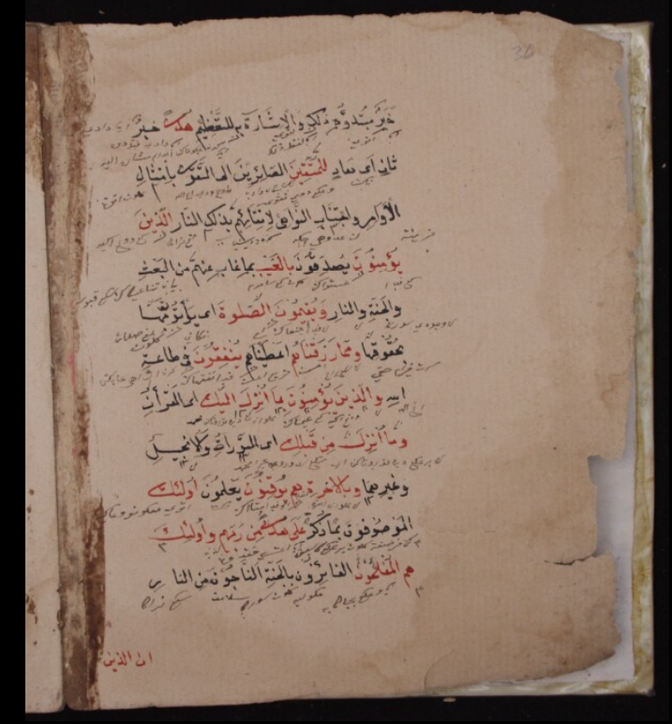
Figure 1. Jalālayn manuscript from Pondok Pesantren Langitan, Tuban, Indonesia. Endangered Archives Programme EAP061-1-105, p.2

Figure 1. Jalālayn manuscript from Pondok Pesantren Langitan, Tuban, Indonesia. Endangered Archives Programme EAP061-1-105, p.2


Due to the belief that the Qur’an cannot be accurately translated, non-Arab Muslims typically rely on tafsīr (Quranic exegesis) to access its content. In contrast to “translation,” tafsīr is accepted as a legitimate practice in any language. Hence, it is logical that the initial translation work to emerge in the Indo-Malay languages was not a “translation” but rather a Malay tafsīr called Tarjumān al-Mustafīd. This tafsīr, authored by the Acehnese scholar Abd al-Rauf as-Sinkili al-Jawi of the 17th century (1105 H/1693 M), is an example. Therefore, if an accurate translation is deemed unattainable, an alternative in the form of a tafsīr using a local language can be superior to a word-for-word or verse-by-verse translation.

Read More

Some scholars argue that after Tarjumān, no translation activity was found until two centuries later, and the need for translation was already fulfilled by Tarjumān. This assumption may not be accurate because (1) several translation manuscripts have been found from those centuries, and (2) the need for a Qur’an translation in the Malay language might not have been as urgent as it is suggested. In fact, from the past until now, Indonesian Muslims who study Islamic sciences have generally used Arabic-language books from an early age.


During my childhood, once I had learned how to read the Qur’an, the next step was to acquire knowledge of the essential sciences of Islam, such as Fiqh (Islamic jurisprudence) and Aqidah (theology). It was typically achieved by studying simple Arabic-language books like Safīnatun Najāh, rather than reading books written in local languages such as Javanese or Malay. Consequently, it became the norm to rely on Arabic books for a comprehensive understanding of the Qur’an, making Tafsīr al-Jalālayn more popular than Tarjumān in this regard. For Muslim students, reading Arabic-language books holds more legitimacy than reading books in local languages.


This assumption is supported by the widespread use of Tafsīr al-Jalālayn as the standard reference for comprehending the Qur’an in various Islamic boarding schools (pesantren) across Indonesia. An example that illustrates how Javanese individuals accessed the Qur’an is a Jalālayn manuscript dating back to the 18th-20th century which was digitized by the Endangered Archive Project (EAP) from Pondok Pesantren Langitan in Tuban, East Java. The EAP has collected numerous similar Jalālayn manuscripts from pesantren in Ponorogo and suraus (Islamic assembly places) in West Sumatra.


This EAP061/1/105 is not a complete Jalālayn manuscript. This volume only includes Surah al-Baqarah to al-Ahqaf, consisting of 461 folios. Based on similar manuscripts, it can be assumed that there is a separate second volume from this manuscript, which may contain Surah Muhammad to Surah al-Fatihah. The arrangement, used in most Jalālayn manuscripts in pesantren including EAP061/1/105, differs from the arrangement of surahs in the Qur’an, which usually starts from al-Fatihah and ends with al-Nas. Manuscripts that start from al-Baqarah and end with al-Fatihah reflect the division of manuscripts based on the author’s order.


As known, Jalālayn is a tafsīr book written by two individuals, Jalaluddin al-Mahalli and his student, Jalaluddin al-Suyuthi. When writing this tafsīr, al-Mahalli started from Surah al-Kahf to al-Nas. When he intended to complete it from the beginning of the Qur’an, he passed away after completing just al-Fatihah and 26 verses of Surah al-Baqarah. The tafsīr writing project was then continued by al-Suyuti, who rewrote it from al-Baqarah, omitting the 26 verses of al-Mahalli’s version, until completing Surah al-Isra. Unlike this manuscript, the current printed version of Jalālayn usually starts from al-Fatihah.


As seen in Figures 1-2, the strategy used by Javanese Muslims to “translate” the untranslatable Qur’an is by translating the Jalālayn. The Jalālayn manuscript itself consists of two texts. The red text represents the verses of the Qur’an, while the black text represents the Jalālayn interpretation. Using two different colours for the Qur’an text and the interpretation is not unique to Indonesia. Several manuscripts from the Middle East also use the same approach.


Javanese individuals employ interlinear translation when working with the Jalālayn. The translation is rendered in black ink and appears smaller in this manuscript. While the Qur’an text and the Jalālayn interpretation are written in naskh script, the Javanese interlinear translation is penned in riq’ah script. This specific writing style, known as “makna gantung” or “makna gandhul” (hanging meaning), is commonly observed in Java. The language utilized in this manuscript is Javanese.


This translation of makna gantung, as shown in manuscript EAP061/1/105, was written by a student in a pesantren. They provided translation notes based on what their teacher (kiai) recited. As seen in Figure 2, the hanging translation by these students is done for both the Qur’an text (red) and the Jalālayn text. It can also be observed that the student leaves some words untranslated. The words left without translation are usually words whose meanings were already known.


Manuscripts like Jalālayn, as shown here, are evidence that the scarcity of Qur’an translations until the 20th century is mostly due to Javanese people who chose to become users of the Arabic language in their study of Islam. Because, in any case, the Arabic language is in their eyes more authoritative than other languages. The motivation to master Arabic is higher than the need to read translations.


Figure 2. Jalālayn manuscript from Pondok Pesantren Langitan, Tuban, Indonesia. Endangered Archives Programme EAP061-1-105, p.3.

Figure 2. Jalālayn manuscript from Pondok Pesantren Langitan, Tuban, Indonesia. Endangered Archives Programme EAP061-1-105, p.3.


Source:

Jalālayn manuscript from Pondok Pesantren Langitan, Tuban, Indonesia. Endangered Archives Programme EAP061-1-105. https://eap.bl.uk/archive-file/EAP061-1-105


Read Less

Interlinear translation of the month #2

Maulid al-Nabī Sharaf al-Anām from Colonial Ceylon

January 2023

Ronit Ricci

Opening page of the Maulid al-Nabī Sharaf al-Anām from Colombo. Courtesy: Jayarine Sukanthi and Thalip Iyne.

Figure 1: Opening page of the Maulid al-Nabī Sharaf al-Anām from Colombo. Courtesy: Jayarine Sukanthi and Thalip Iyne.

Maulid (or maulud) texts depicting the episodes surrounding the Prophet Muhammad’s birth and singing his praises have been known in the Indonesian-Malay world since at least the 18th century. They are recited in commemoration of the Prophet’s birth (celebrated on the 12th of Rabi‘ al-Awwal) and on other occasions such as marriages and circumcisions. One of the most popular among these maulids in the region is the undated and anonymous Maulid Sharaf al-Anām (“The Birth of the Best of Mankind”), composed in Arabic and known by Muslims from Ethiopia to the Philippines.

Read More

The exemplar to be discussed here is from colonial Ceylon (present-day Sri Lanka). The original Arabic text was copied in Colombo in 1891. The small manuscript measuring 15x10 cm and containing 98 pages includes, besides the Arabic text, a Malay interlinear translation. On the cover are written in black ink the title and the owner’s name: Muhammad Mu‘in al-Din ibn Baba Yunus Saldin (known as M.M. Saldin). According to a note in Malay on the manuscript’s second page the manuscript was gifted to the owner by encik Junus Tumurtu, who, as clarified by a brief note in English on the inner cover, was his maternal grandfather who presented the manuscript to him in 1910. [1]It was later inherited by Mrs. Jayarine Sukanthi Iyne, M.M. Saldin’s granddaughter, and is presently in the possession of her family in Colombo. It was digitized as part of the British Library’s Endangered Archives Programme (“Digitizing Malay Writing in Sri Lanka,” EAP609) and is listed as item EAP 609/5/4, available at https://eap.bl.uk/archive-file/EAP609-5-4

The manuscript is in very fragile condition, with some pages falling out and the binding loosely connected. It is illuminated on its first two and last two pages in red, green, blue, brown and black, with flowers, leaves, buds and geometrical designs framing these pages (see Figure 1). All other pages exhibit a simple, double-lined frame in red ink. The Arabic is written in black ink while the Malay is written in a lighter shade of gray and a smaller unvocalized script, known across Southeast Asia as jawi and in Sri Lanka as gundul. The hand of the Arabic text and the translation is not the same. On the initial five and a half pages, written in poetic verse in which all lines begin with “assalamu ‘alaika,” only the second half of the lines is translated, beyond the first instance (which includes the translation “salam atasmu hai Muhhmad.” The translation is written with a slant beneath each straight Arabic line, sometimes extending beyond the end of the line and red frame, especially in the pages’ bottom lines (see Figure 2).

A page from the Maulid al-Nabī Sharaf al-Anām where the extension of the translation beyond the frame is visible.

Figure 2: A page from the Maulid al-Nabī Sharaf al-Anām where the extension of the translation beyond the frame is visible.

The manuscript offers testimony to the ongoing connections between the small diasporic Malay community in colonial Ceylon and the Indonesian-Malay lands to the southeast. Not only was the Sharaf al-Anām among the most popular mauluds in that broader region but it was also selected for translation via the interlinear method, most often into Malay, in different sites across it, including Aceh, Java, Makassar and Patani from the 18th century onwards. Composed in part-prose, part-poetry it stands out among numerous interlinear translations from the region that are more prescriptive and less narrative in nature. A comparison among such interlinear translations of the same devotional Arabic text reveals both local particularities and a strong standardizing impulse, the understanding of which will require much further research. Preliminary findings point to the Ceylon translation in some ways resembling a Javanese interlinear translation of the Maulid more than it resembles other Malay interlinear translations of the text. For example, both the Ceylon exemplar and one from Java (British Library, MS. Or 16873) add titles (that do not appear in Arabic) to various figures depicted in the narrative and they also tend to clarify details (e.g. inserting a name into the translation rather than employing ‘ia’ or ‘nya’ which translate the Arabic pronominal suffixes more precisely) where other Malay translations do not. These similarities may reflect the strong demographic and cultural Javanese element within the broader, diverse diasporic community that over time came to be designated as “Malay.”


References:

Maulid Sharaf al-Anām. British Library MS. Or. 16873

http://www.bl.uk/manuscripts/FullDisplay.aspx?index=23&ref=Or_16873

Maulid Sharaf al-Anām. EAP 609/5/4 https://eap.bl.uk/archive-file/EAP609-5-4

Ricci, Ronit. Banishment and Belonging: Exile and Diaspora in Sarandib, Lanka and Ceylon (Cambridge: Cambridge

      University Press, 2019).


[1] On the history of the Saldin family in colonial Ceylon see Ronit Ricci, Banishment and Belonging: Exile and Diaspora in Sarandib, Lanka and Ceylon (Cambridge: Cambridge University Press, 2019) especially pp. 218-244.

Read Less